

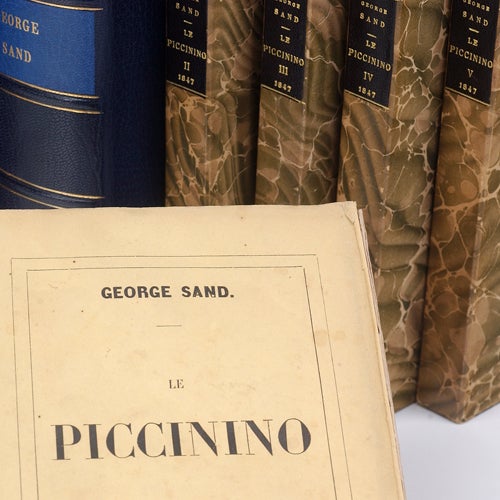
Piccinino, Le
Paris: Desessart, 1847. Item #00303
"Piracy, Banditry and Disorder"
Bewitching Beauty Inflames Desires
Uncut, in the Original Printed Wrappers
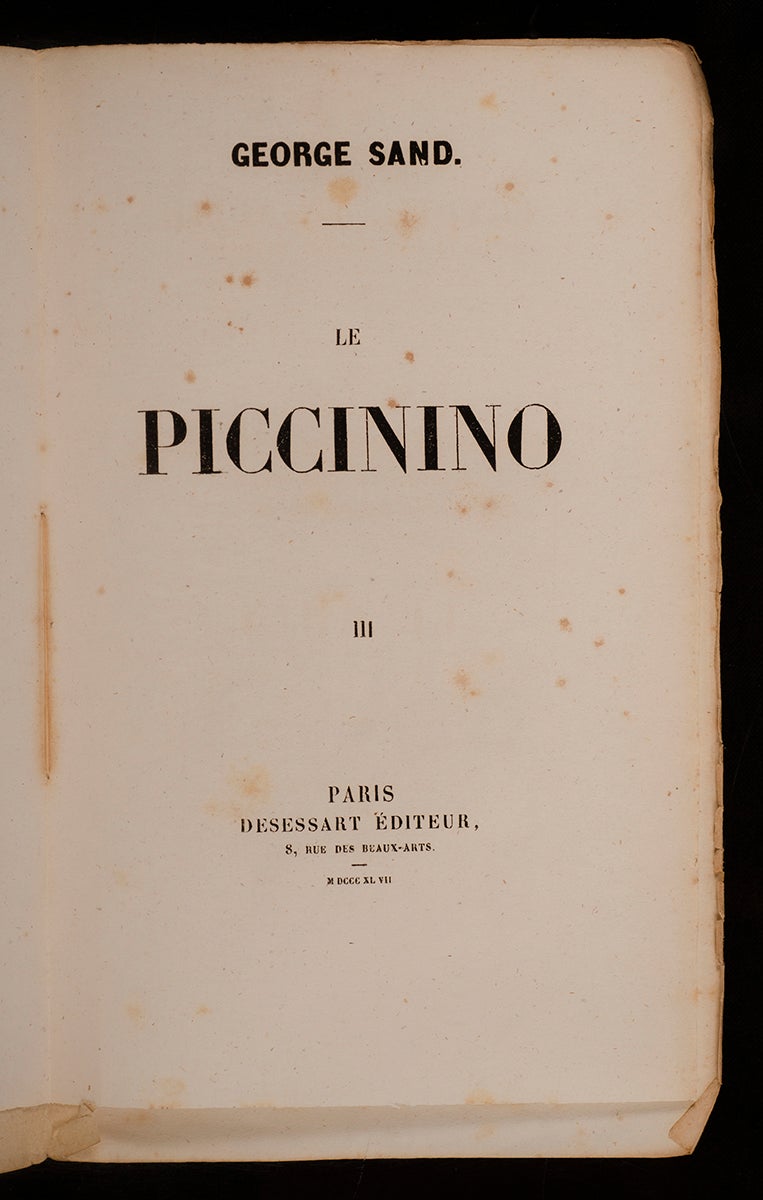
SAND, George. Le Piccinino. Paris: Desessart, Éditeur, 1847.
First edition. Five octavo volumes (9 1/16 x 5 7/16 inches; 231 x 139 mm.). [4], 315, [1, blank], [1, “Table”], [3, blank] (final blank leaf pasted to rear pastedown); [4], 301, [1, blank], [1, “Table”], [1, blank]; [4], 307, [1, “Table”]; 308, [1, “Table”], [3, blank] (final blank leaf pasted to rear pastedown); [4, advertisements], [4], 318, [1, “Table], [1, blank] pp.
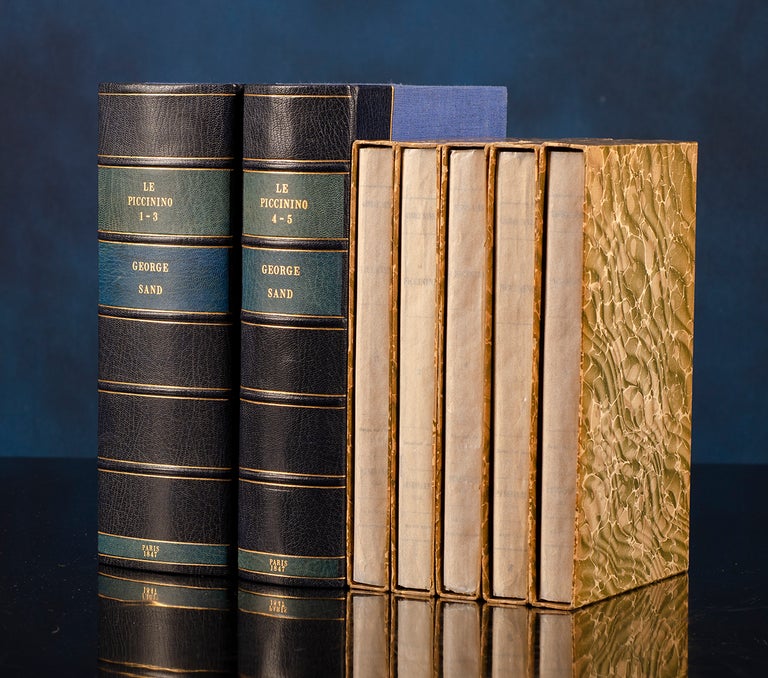
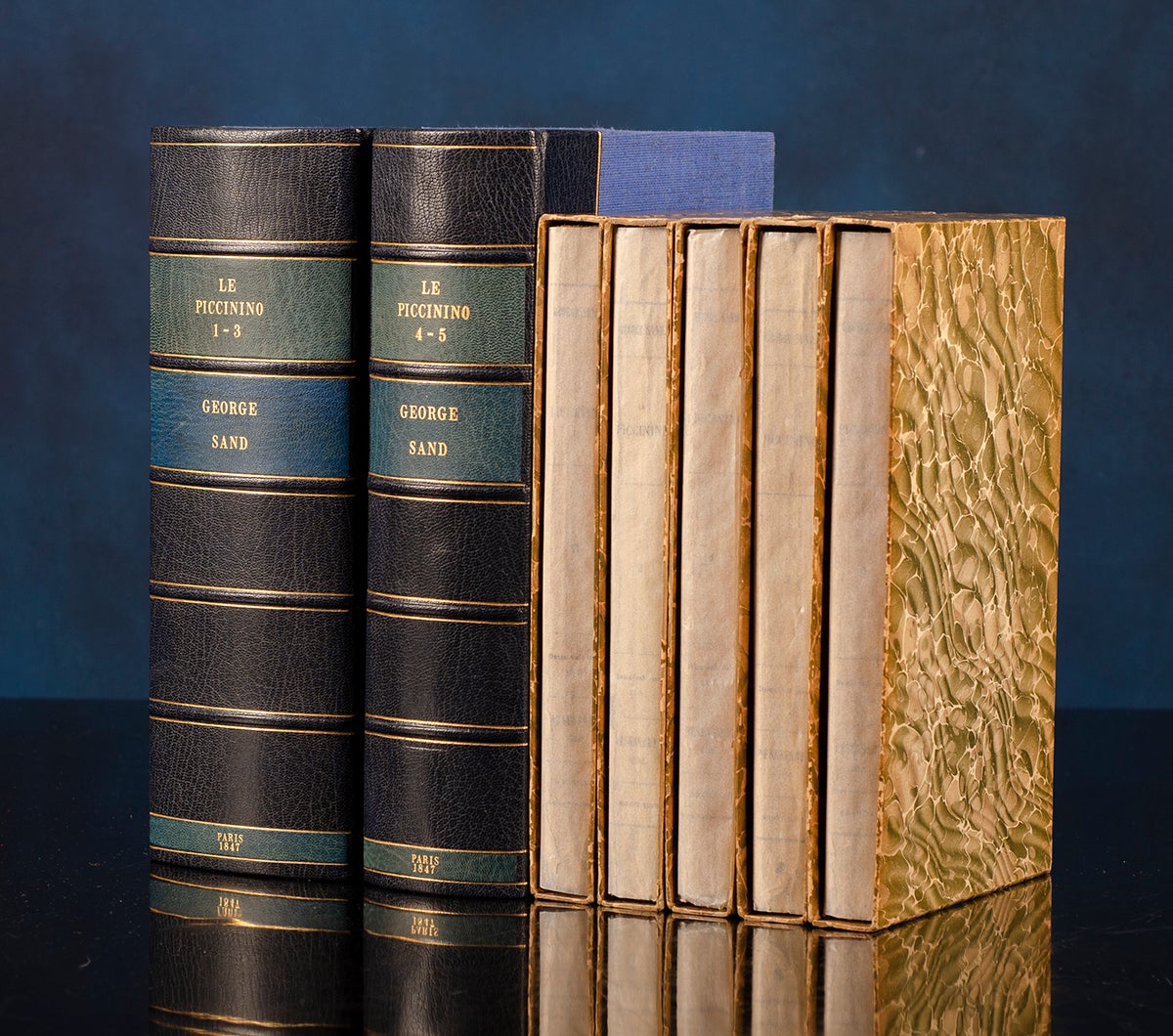
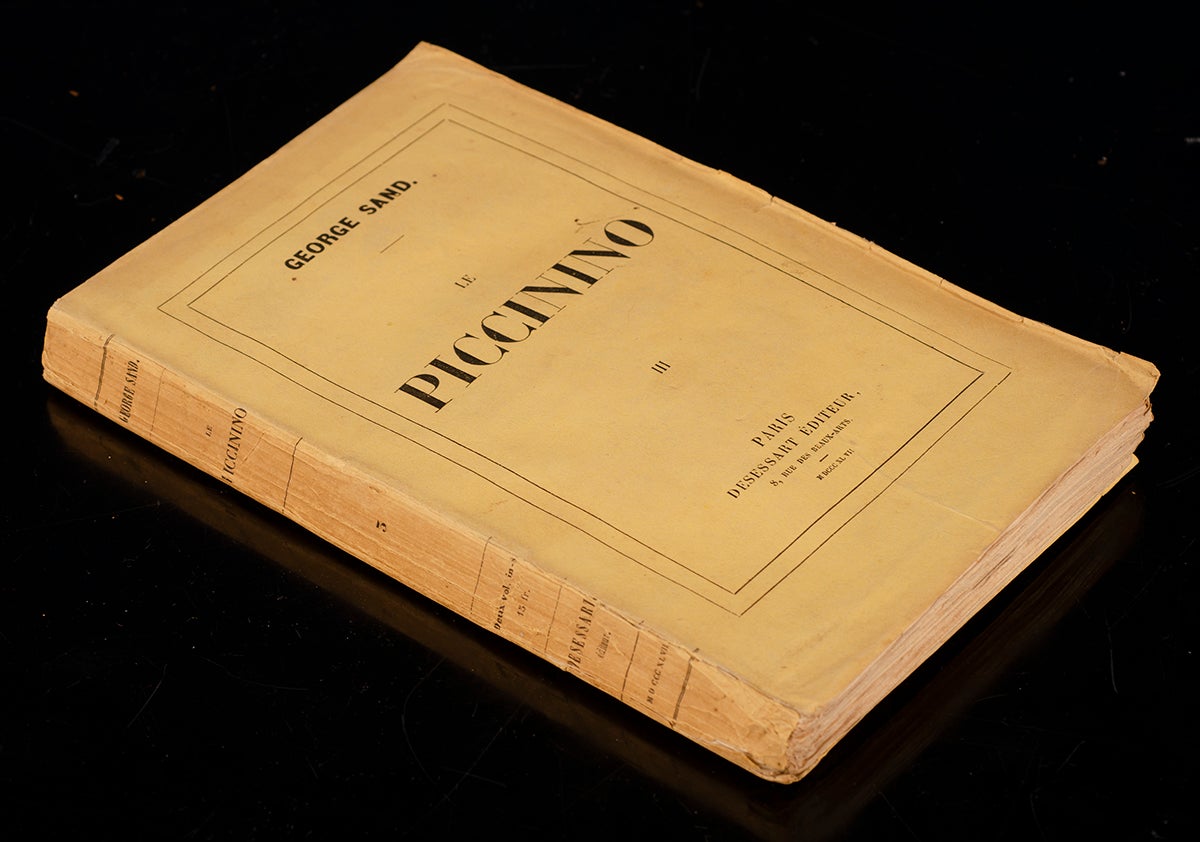
Uncut, in the original yellow printed wrappers, protected by glassine wrappers. Advertisements on rear wrappers. Minimal chipping to wrappers, spines slightly darkened, some light foxing and edge browning, as usual. A wonderful set. Each volume housed in a marbled board slipcase and the five volumes housed together in two quarter dark blue morocco over royal blue cloth clamshell cases, spines with five raised bands ruled in gilt, three morocco labels of differing blues lettered in gilt. A remarkable survival.
A fantastical and romantic tale of mistaken identity, erotic obsession, and aristocratic intrigue, Le Piccinino follows the fateful course of a beautiful Sicilian girl - raised among brigands and peasants - whose origins, like her destiny, are shrouded in mystery. She moves through a sun-drenched landscape of artists, outlaws, princes, and adventurers, inspiring adoration and chaos in equal measure.
In this richly imagined and theatrical narrative, Sand celebrates invention over realism, placing the novel firmly within her later romantic oeuvre that privileged exoticism, imagination, and the internal landscape of female identity. Piracy, banditry, smoldering secrets, and hidden bloodlines abound.
"The Piccinino is a novel of fantasy," writes George Sand in her preamble, "which has no claim to paint a precise historical epoch, nor to accurately describe a country. It is a study of color, dreamed rather than felt, and where only a few features have been found just as by chance. The scene of this novel could be placed everywhere else, under the sky of the south of Europe …". A story full of fascinating family secrets from one end to the other…
Astonishingly, only one (the present copy in 1989) of this novel featuring "piracy, banditry and disorder" has come to auction within the last fifty years.
"Nothing could be more charming than her tales of mystery, intrigue, and adventure…Le Piccinino [et al] - these things have all the spontaneous inventiveness of the romances of Alexander Dumas, his open-air quality, his pleasure in a story for a story's sake..." (Henry James, Literary Criticism: French Writers, p. 730).
On April 16, 1847, Chopin wrote to his family: “her new romance entitled (thus far) Piccinino (which means: little). The action takes place on Sicily. Many lovely things; I do not doubt that it will be more to Ludwika’s liking than [Sand's] Lucretia, which also aroused less enthusiasm among others here…A great deal of naturalness, of poetry, I remember what a pleasure it was to listen to her reading it” (Fryderyk Chopin—Calendary).
George Sand (pen name of Amandine Lucie Aurore Dupin, Baronne Dudevant, 1804-1876) “was as famous for her ‘unfeminine’ independence, her habit of wearing men’s clothes, and her love affairs with such prominent artistic figures as Alfred de Musset and Frédéric Chopin, as for her writings. In 1831 she left her husband, Baron Dudevant. Her work is usually divided into three distinct periods, the first of which, intensely romantic, corresponds to her affair with Musset… The novels of this period plead the right of free love for both men and women, and include such works as Indiana [1832], Lélia (1833), and Valentine (1832). During the next decade George Sand became interested in various humanitarian reform movements and published such works as Consuelo (1842) and Le Meunier d’Angibault (1845). Her last group of novels, sentimental studies of nature and of rustic manners, includes La Mare au diable (1846), Le Piccinino (1847), La Petite Fadette (1848), and François le Champi (1850)” (Benét’s Reader’s Encyclopedia).
Vicaire VII, col. 231. Not in Carteret.
Price: $3,500.00